0:00
Hi, I'm Cla Connor, principal consultant
0:02
at Genies AI. Gil, why don't you
0:04
introduce yourself?
0:05
And I'm Gil Pelleg. I'm co-founder and
0:08
CEO here at Genies. Uh, for those who
0:10
don't know me, I've been in the
0:12
mainframe space for now 27 years. And
0:15
previously, I was the founder and CEO at
0:17
Model 9, which was acquired by BMC. And
0:21
then my co-founder Dan Sprung and myself
0:24
started Genies. And uh, happy to tell
0:27
you all about it today.
0:28
Great. Why don't you start by telling us
0:30
how you see Gen AI in the mainframe
0:32
space?
0:33
We see the market sort of divided into
0:35
three areas. One is AI on Z. Uh that's
0:39
not really generative AI. That's more
0:41
traditional AI models running on the
0:43
mainframe designed for transactional use
0:46
cases such as fraud detection. Uh
0:49
another category is the code assistance
0:52
or code modernization.
0:54
uh we perceive this not as a mainframe
0:57
vendor space but more as a hyperscaler
0:59
space around code modernization. We see
1:02
Amazon Q, we see Microsoft Copilot, we
1:04
see Gemini Antropic offering things
1:07
around Cobalt. Um but our focus is
1:10
really on the right hand side of this
1:12
slide where the generative AI race is
1:14
happening where we see every week new
1:16
innovation from open AI from anthropic
1:20
from Gemini uh and Amazon Bedrock and
1:22
our mission here at Genies is to bring
1:24
that innovation to the mainframe space.
1:27
Great. What is it that Genies actually
1:29
does?
1:31
So uh Genies is a software product. We
1:33
call our product the Genies Genai
1:35
framework. At the core, it's a
1:38
technology to deliver real time
1:40
mainframe data to AI applications. Uh,
1:44
it's a mainframe native application. So,
1:46
it runs on the zip engines. It uses the
1:49
mainframe security controls in WLM, but
1:53
it supports all the leading LLMs and AI
1:57
agents in the industry. On top of that
2:00
technology, we have built what we call
2:02
the genies, which are AI assistants
2:05
designed to help mainframe professionals
2:07
specifically to do their job better and
2:10
faster.
2:11
So, can you share a use case for each
2:13
genie?
2:14
Yeah. So, uh we have four uh main
2:17
genies. One for operations, for
2:20
security, for application modernization,
2:22
and for capacity planning and
2:23
performance. What is a genie? A genie is
2:26
a chat interface on top of mainframe
2:30
data sources. So for example the
2:32
operations genie. It sits on top of uh
2:35
the live SMF stream on top of job
2:38
outputs from the spool on top of your
2:41
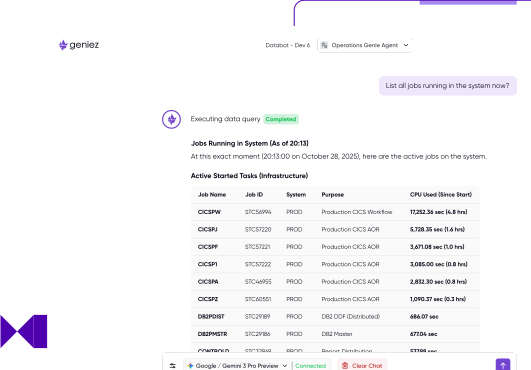
sys log and you can ask it questions
2:44
around operational insights such as uh
2:47
show me the top CPU consuming jobs in
2:49
the system or what's my 4hour monthly
2:52
pick window or you can use it for
2:55
troubleshooting uh the system for
2:58
example if you see the system is slow
3:00
you can say okay I've noticed my system
3:02
is low in the past 5 minutes. Can you
3:04
have a look and tell me why are
3:07
transactions delayed? Uh the security
3:09
genie is designed more for security
3:12
professionals to identify changes in
3:14
permissions, check for vulnerabilities
3:16
and for audit and compliance purposes.
3:19
Uh application modernization is more
3:21
about mapping your application assets,
3:24
what's active code, what's inactive, uh
3:27
streaming mainframe data from the
3:29
mainframe to the cloud. And the last one
3:32
is the capacity planning uh genie that's
3:35
focused on system performance. So you
3:38
can use it to assess MYIPS consumptions
3:40
by job. You can uh check CP versus zip
3:43
uh utilization or you can even compare
3:47
execution of several jobs.
3:50
That's great. Um and what does the
3:51
architecture actually look like?
3:54
So it's a pretty straightforward
3:55
architecture. We have two main
3:57
components to the to the uh product. One
4:01
is the framework server. That's a
4:03
containerized application uh running on
4:06
a Linux server. It can run on premises
4:09
close to your mainframe or it can run in
4:12
the cloud close to your LLM. The second
4:15
component is what we call the mainframe
4:17
data bot. That's a mainframe starter
4:19
task. It's written in Java and it runs
4:22
on the zip engines and that's what's
4:25
actually accessing the mainframe data
4:27
sources, extracting data and sending it
4:29
back to the framework. The final
4:32
component is the LLM. Uh you can use any
4:36
industry-leading LLM either open AI or
4:40
from anthropic gemini or you can even
4:42
use mist running on prem for example.
4:45
And uh how does the security work? I
4:47
think it's going to be really important
4:48
for everyone listening. So if you can
4:50
give us a a bit of an overview on the
4:52
security of our framework.
4:53
Definitely. So we have built the product
4:56
with a security first design meaning we
4:59
first figured out the security and then
5:02
uh built the product on top of it. It's
5:04
patented technology and the way it works
5:07
is that uh when a client h identifies to
5:11
the framework it uses an API key. that
5:14
API key is associated with a rackf ID
5:18
and any mainframe data access is
5:22
verified against that rakf ID. So if you
5:25
trust RAKF, you should trust the
5:28
framework security controls. And by the
5:30
way, it doesn't have to be RAK only. It
5:33
can be top secret or ACF2. And just one
5:36
uh additional thing to to know about the
5:40
security architecture is that we have
5:43
worked really hard to minimize the
5:45
attack surface. The datab does not
5:47
require any APF authorization. It
5:50
doesn't require UID0. So it's really a
5:53
standard application on the mainframe.
5:56
That sounds really good. Um can it query
5:59
other data sources? Um can you give us a
6:01
summary of what it can access?
6:03
Yeah, so we support quite a few
6:05
mainframe data sources both application
6:08
level and system level. So on the
6:10
application level we support the popular
6:13
databases such as DB2, MQ, VISM data
6:16
sets or any cobble map data set. Uh on
6:20
the system side we support the live SMF
6:22
stream. We support the SIS log, the
6:25
opera log. We can check job outputs. We
6:28
can access the rack of the database for
6:30
example. And if that's not enough,
6:32
customers can also provide their own
6:35
plugins to access unique data sources
6:38
that they have in their environment.
6:40
I that sounds really exciting. So let's
6:42
assume a customer wants to install this.
6:45
Um how complicated is it and and what
6:48
are the prerequisites? So, it's a very
6:51
straightforward installation from what
6:53
we see customers typically get up and
6:55
running in less than 4 hours. Uh, the
6:59
framework, all it requires is a Linux
7:01
server and Docker installed. On the
7:04
mainframe side, all you need is Java 17
7:08
or 21. Uh, and that's pretty much it.
7:11
You don't need any additional software
7:15
uh set up. So you don't need ZOSMF, you
7:19
don't need ZOS connect, you don't need
7:21
any specific monitor. The framework and
7:23
the datab are everything you need to
7:25
start quering mainframe data sources.
7:28
That sounds great. So to summarize, um
7:31
I'm a mainframe professional. Give me
7:32
three reasons why I should look at
7:34
Genies.
7:34
Yeah. So uh first of all, Genies can
7:37
help you understand why something is
7:38
happening and not only what's happening
7:41
in the system. It can make you more
7:44
efficient and save you a lot of time on
7:46
your day-to-day activities and it can
7:49
even save you money by helping you
7:52
recover quickly from system issues.
7:54
That sounds great. Uh, thank you Gil for
7:56
taking the time with us today. Um, if we
7:59
want to learn any more about it, where
8:00
can we go?
8:01
We have a lot of information and
8:03
resources on our website. So, we invite
8:05
you to uh check the website and reach
8:08
out through there.